Saturday, August 30, 2014

"The Cost of the Kingdom" - August 31, 2014

Matthew 16:21-28

            Tomorrow is Labor Day.  We will celebrate it, mostly, with a day off.  There will be cookouts and horse shoe tournaments and it will be treated as the last day of summertime.  That’s fine.  We need holidays like that to mark the end of one season and the start of the next.  We are humans, and the awareness of time is a big part of who we are.  Just don’t forget, on the day off, that it is also a day to remember and honor the people whose work makes leisure possible.

            How often we take such things for granted.  We like to think that things come easy.  We celebrate the talent and skill of a Yo-Yo Ma or a Serena Williams and forget how many hours they spent as children and still spend as adults learning and perfecting where to place their feet and how to move their arms.  We read a good novel and never give a thought to how many pages were written and then erased, how many drafts were needed to get it right.

            Peter wanted to look at the kingdom of God that way.  Jesus told his disciples one day about the work and suffering that he would put into our salvation and Peter almost brushed it off.

“Jesus began to show his disciples that he must go to Jerusalem and undergo great suffering at the hands of the elders and chief priests and scribes, and be killed, and on the third day be raised.  And Peter took him aside and began to rebuke him, saying, ‘God forbid it, Lord! This must never happen to you.’” [Matthew 16:21-22] 

Jesus recognized the temptation in this, and he responded by calling Peter on it, and even using the tempter’s name

“he turned and said to Peter, ‘Get behind me, Satan! You are a stumbling-block to me; for you are setting your mind not on divine things but on human things.’” [Matthew 16:23]

There could be no shortcut to heaven that would go around the work and the pain of the cross, as appealing as it would sound.

            Jesus had heard that idea earlier.  Before he ever set out on his ministry, he had been in the desert where the devil had suggested all kinds of shortcuts and quick fixes and ways for Jesus to reach his goals if – and “if” was the catch – he took a different road.  The culmination came when

“Again, the devil took him to a very high mountain and showed him all the kingdoms of the world and their splendor; and he said to him, ‘All these I will give you, if you will fall down and worship me.’ Jesus said to him, ‘Away with you, Satan! for it is written,
“Worship the Lord your God,
   and serve only him.” 
[Matthew 4:8-10]

Jesus tried to convey to his followers, who loved him and did not want to see him suffer, that there was no other way.  To be faithful to God and God alone means that there will inevitably come the time of choice and of testing and of confrontation, and with it the suffering of a cross. 
           
            It’s a hard lesson to learn.  In fact people do all that they can do not to learn it.  In her memoirs about a particularly difficult time in her own spiritual life, when she was feeling that she had to set aside a lot that had made her life not easy (for she struggled to help her husband with his alcoholism and depression) but easier than it had become, Kathleen Norris writes,

"All of us, I suspect, have times when we're made to suffer simply for being who and what we are, and we become adept at inventing means of escape.  ...the pain that grows out of one's identity, that grows out of the response to a call, can't be escaped or pushed aside.  It must be gone through."[1]  

She had learned from what Jesus had told his disciples.  He could not turn away from doing the work that would build the kingdom, and neither could they.

“Jesus told his disciples, ‘If any want to become my followers, let them deny themselves and take up their cross and follow me. For those who want to save their life will lose it, and those who lose their life for my sake will find it. For what will it profit them if they gain the whole world but forfeit their life? Or what will they give in return for their life?’”  [Matthew 16:24-26]

            Jesus and his followers fell into a pattern over time, where he would teach about what life in the kingdom is like, and they (meaning “we”) would try to modify it, and he would have to emphasize that he meant what he said in the first place.  For instance, Jesus taught that we should be forgiving.  That seems pretty straightforward but we all know that it is rarely so simple.

“Then Peter came and said to him, ‘Lord, if another brother or sister sins against me, how often should I forgive? As many as seven times?’ Jesus said to him, ‘Not seven times, but, I tell you, seventy-seven times,’” [Matthew 18:21] 

or, as some ancient versions say, “seventy times seven.”  Either way, it’s clear he means it.  Luke has Jesus teaching his disciples,

“If the same person sins against you seven times a day, and turns back to you seven times and says, ‘I repent,’ you must forgive.” [Luke 17:4]

I’ll admit that I hear that and the first thing I do is say to myself, “Aha!  They have to repent!  And if they’ve done wrong that often, how serious do I think it really is?”  I look for the loophole.  Yet how often do I ask forgiveness for the same sins, over and over and over?  More than 490 times, I guarantee.

            So much of what Jesus says seems backwards and upside down and inside out.  How should his death be the source of our life?  And if we have found life in him, why would we need to have anything to do with a cross of our own? 

What would make sense would be to say that you have to work hard to become part of the kingdom of God, then when you’ve made it, you can enjoy the ride.  What Jesus says is that the kingdom of God is right at hand, and that anyone is welcome and everyone is invited, but once you are part of it, then the hard work begins. 

“For those who want to save their life will lose it, and those who lose their life for my sake will find it.” [Matthew 16:25] 
           
It would be as if someone invited just anybody in off the street to a wedding reception and then looked at one of these haphazard guests and said, “What’s the matter with you, showing up at a wedding without even getting dressed up a little?” [Matthew 22:12] 

            Yet the lives of Jesus’ followers attest that the way he works sees them through to the end.  Our common image of William Penn comes from the Benjamin West painting of his treaty with the Indians.  
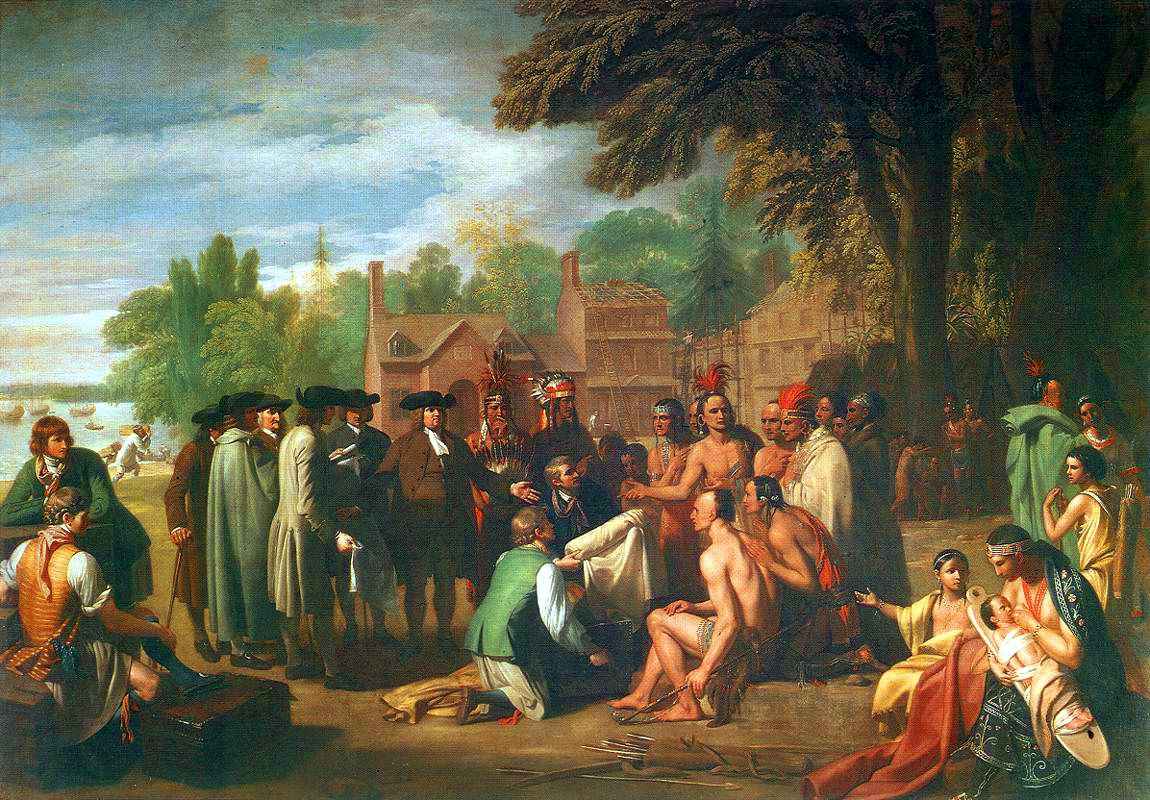

There stands an older, paunchy man in a floppy, brown coat, the negotiator calmly standing between the settlers anxious to take over the land and the natives anxious not to be tossed out.  In fact, Penn could and did hold his own in argument and dispute and had been tossed into both Newgate Prison and the Tower of London earlier in his life.  In the Tower, Penn was allowed to have paper and ink so that he could write a recantation of his views.  He used it, instead, to write a pamphlet he entitled, “No Cross, No Crown”, in which he said,

“God often touches our best comforts, and calls for that which we most love, and are least willing to part with.  Not that He always take it utterly away, but to prove the soul’s integrity, to caution us from excesses, and that we may remember God, the author of those blessings we possess, and live loose to them.  I speak my experience:  the way to keep our enjoyments is to resign them; and though that be hard, it is sweet to see them returned, as Isaac was to his father Abraham, with more love and blessing than before.  O stupid world!  O worldly Christians, not only strangers, but enemies to this excellent faith! and whilst so, the rewards of it you can never know.”[2]

To be faithful in a faithless world means that sooner or later you will come into conflict with values and practices that just don’t fit with Jesus’ ways.  When that happens, hold on tight.  The ride will be rough, but the landing will be safe, and you will be home.


[1] Kathleen Norris, The Cloister Walk (New York: The Berkley Publishing Group, 1987) 38.

[2] William Penn, “No Cross, No Crown” 4.xiii.  See http://www.gospeltruth.net/Penn/nocrossnocrownch4.htm .

Saturday, August 23, 2014

“The Keys to the Kingdom” - August 24, 2014

Matthew 16:13-20

            If you walk down the hallway and go into the chapel, you’ll see windows that have symbols of all the twelve disciples.  On the left, the first window you come to will have two crossed keys and the name Peter.  That symbol comes from the words of Jesus that we heard read this morning, where he tells Peter,

“I will give you the keys to the kingdom of heaven, and whatever you bind on earth will be bound in heaven, and whatever you loose on earth will be loosed in heaven.” [Matthew 16:19]
In the window, and in other places where the symbol appears, like the Vatican’s coat of arms, one key is gold and the other is iron to suggest the power to open or close the gates of heaven. 

            There’s something tremendously audacious in the claim that issues from this, that any human being can open or close the way to heaven for anyone else.  Sometimes when somebody dies, a concerned relative will ask me, “Is so-and-so in heaven?”  My answer is always going to be, “That’s not my call.  But I do trust that God is merciful and loving, and that Jesus said he was going there to prepare a place for us.”  It really isn’t up to you or me to make these calls.  Now, sometimes you do get that gut feeling about someone that if anyone is in heaven, they are.  For the most part, I’d advise you to go with that.  It doesn’t mean that they were perfect or flawless.  It just means that you could see God’s grace working in and through them while they were among us, so you can probably safely assume that God’s grace is with them still in an even more wonderful and powerful way.

            On the other hand, there may be people whose lives or deaths leave you wondering.  Someone who is tortured by mental illness, who goes through some horrible depression, or who spends long years with physical pain, for example, may take their own life in despair.  What about them?  Again, I’ll repeat: “God is merciful.”  We do not know what happens between anyone else and the Lord.

            Kevin Hines is one of the very few people to survive a jump off the Golden Gate Bridge.  When he was interviewed on NPR a few weeks ago, he described his experience like this:

“I went down about 70 to 80 feet, but then I opened my eyes, and I thought, ‘What the heck?’ I thought I was hallucinating this entire event. I thought I couldn’t have just done that. That didn’t just happen. And I wouldn’t be alive — so, of course, it didn’t just happen. But when I finally resurfaced after initially going down — and after nearly passing out and drowning — I broke the surface, I bobbed up and down in the water, and I simply prayed, ‘God please save me I don’t want to die, I just made a mistake.’ As I bobbed up and down in the water, swallowing salt water and trying to stay afloat only using my arms because my legs were completely immobile, something brushed by my legs. I thought, ‘You gotta be kidding me.’ I thought, ‘This is ridiculous. I didn’t die off this bridge and now a shark is gonna devour me?’ Turns out it was not a shark, it was, in fact, a sea lion. The people above looking down, who were on the bridge, believed it to be keeping me afloat until the Coast Guard boat arrived.”
Later in the interview he said,

“I went back with my father a year after the attempt. And, ya know… we’re driving — he said, ‘Kevin, we’re gonna take a drive.’ And I saw where we were going and I said, ‘Dad, what’re you doing?’ and he goes, ‘Well, we gotta find some closure Kev.’ We stopped by a flower bed on the way and he said, ‘Pick a flower.’ So I picked a flower from the flower bed. And we got in the car and went all the way out to the Golden Gate Bridge parking lot and we parked and he walked with me to exactly where I jumped. We said a prayer and we dropped the flower. The flower hit the water and, two feet to the right, popped up a sea lion. So, I know I’m supposed to be here, and I know there’s a reason why. I guess, I’ll just be finding that reason out as life goes on.”[1]
So, my point in repeating his story is simply that there is no telling how or when God is at work in anybody’s living or dying until God lets us know.

            What we do know, however, is that even though we do not have the ability to say who walks through the gates of heaven when their time does come, we do have the ability that Peter had to let people know that Jesus has opened them up.  That is the golden key.  We also have the ability to stay quiet about that, which is the iron key.  What happens for others may very well hinge on whether we speak out or keep silent about the very declaration that Peter made when he replied to Jesus,

“You are the Christ, the Son of the living God.” [Matthew 16:16]
It is on that declaration that the Church is built, not Peter, but on the faith that he expresses,

”and on this rock,” said Jesus, “I will build my Church and the gates of Hades will not prevail against it.” [Matthew 16:18]
The faith that Jesus is the one sent to help us is always going to be a faith that says that the door is open, that there is hope, that there is welcome, that – no matter what – God is merciful.  When we speak that, and when we live that out, we use the golden key that may open heaven for someone who is looking for the way in.

            That can be a powerful responsibility that shapes our own lives.  John Wesley was someone who had a great sense that the keys to the kingdom should not sit in his pocket.  In his Journal entry for Saturday, June 12, 1736 he wrote:

“Being with one who was very desirous to converse with me, but not upon religion, I spoke to this effect – ‘Suppose you was [sic] going to a country where everyone spoke Latin, and understood no other language, neither would converse with any that did not understand it: suppose one was sent to stay here a short time, on purpose to teach it to you; suppose that person, pleased with your company, should spend his time in trifling with you, and teach you nothing of what he came for.  Would that be well done?  Yet this is our case.  You are going to a country where everyone speaks the love of God.  The citizens of heaven speak no other language.  They converse with none who do not understand it.  Indeed, none such are admitted there.  I am sent from God to teach you this.  A few days are allotted to that purpose.  Would it be well done in me, because I was pleased with your company, to spend this short time in trifling, and teach you nothing of what I came for?  God forbid!  I will rather not converse with you at all.  Of the two extremes this is the best.”
I’m not sure that everybody is called to push things quite that far, but I am sure that all Jesus’ followers are called to learn the language of heaven, to speak the language of heaven, and to teach the language of heaven, and that when we do so, it is the golden key that we hold out. 

            Neither you nor I nor anyone else will ever force anybody into the kingdom, but it’s our privilege and duty to hold the door, and not to be surprised if that means someone we might never even expect goes in before we do.

            A preacher climbed into a taxi cab.  He was late for a flight to the airport.  The driver said, “I’ll get you there on time.  Don’t sweat it.”  He took off through traffic, and swerved from lane to lane, and ran a few red lights until they were on the highway.  Once there, he hit eighty miles per hour.  That was when a tire blew out and the taxi spun out in front of a tractor trailer.  Both the passenger and the driver were killed.  Their souls appeared instantly at the gates of heaven, where St. Peter met them.  He saw the preacher and said, “Welcome!” and introduced him to an angel that would show him around.  Then he turned to the taxi driver and said, “Welcome!  Come over here!” and he seated him on a big float made out of a cloud with rainbows for wheels and a brass band marching in front and behind him. 

“I don’t get it,” said the preacher.  “What did he do that merits this kind of welcome?  The man drove like a maniac and got us both killed.”

“Exactly,” said Peter.  “When you preached, people thought about what you were saying.  When he drove them, they prayed.”


[1] http://hereandnow.wbur.org/2014/07/07/suicide-nets-golden-gate-bridge

Saturday, August 16, 2014

"Watch Your Mouth" - August 17, 2014

Matthew 15:10-20


            The news recently has had a lot of stories about anti-Jewish riots and attacks across Europe, and sometimes there are similar hate-crimes committed in this country as well.  We should own up to and confess that for centuries the Church kept silent when this happened or, even worse, spurred the hatred on.  We cannot let that happen anymore.  It is no different than what goes on when our own Christian sisters and brothers in Syria and Iraq and Nigeria are attacked by people calling themselves Muslims (who also attack their own sisters and brothers) and they, in justifiable fear, remain silent.  We have no excuse.  What comes out of our mouths may be hate, or may be love, and that is a sign of what lies deep in our hearts.

            It’s always important that we remember that Jesus was not, in our terms, a Christian.  He did not celebrate Christmas (and the Bible never says his birthday was in December); he was not baptized in the name of the Father, Son, and Holy Spirit (although all three were there when John the Baptist did baptize him in the Jordan River); and though I expect he celebrated his resurrection more than anyone else ever has, it probably came with as much sense of relief as anything – as much a physical reaction as a spiritual one, for him.  Jesus was, as the Bible clearly tells us, a good, God-fearing Jew.  He was welcomed into the world with the proper sacrifices in the Temple, where his family returned on a regular basis as they could.  He went to synagogue on the Sabbath, our Saturday.  He observed the Passover, and transformed it into the meal that we share at the Lord’s Table.

            He knew the Law of Moses.  He respected the Law of Moses.  That is why it strikes such an odd chord when he says,

“Listen and understand: it is not what goes into the mouth that defiles a person, but it is what comes out of the mouth that defiles.” [Matthew 15:10-11]

After all, isn’t so much of the Hebrew Bible about what you should or should not eat?  Kosher laws are more than just not eating pork.  To this day an observant Jew who reads Deuteronomy 14:21, “You shall not boil a kid in its mother’s milk”, knows that means that veal parmesan and cheeseburgers are also out of line.  Likewise, based on other passages, you can forget about the clams casino and the shrimp cocktail.  Jesus knew all of that.  He also knew not to work on the Sabbath, not to mix different fibers in his clothing, and to avoid touching or getting too close to lepers.  Jesus, however, cared far more about the purpose of the Law than for the details.
           
            Have you ever had a broken arm and had to wear a cast?  You know it’s for your own good but it’s also burdensome.  Every moment of the day you have to think about this big, clunky thing at your side.  You wake up at night with an unaccustomed weight pulling your shoulder to the side.  It makes you very much aware of the very existence of your appendages in a way that you aren’t most of the time.

            The Law can be a bit like that.  It provided for a lot of good.  Pork, after all, was a great source of trichinosis when it isn’t properly cooked.  Unrefrigerated shellfish are not a good thing to eat anytime, but especially in hot climates.  Keeping the Sabbath is important for physical as well as spiritual well-being.  Above all, though, the many requirements of the Law served as a reminder of God’s involvement in every aspect of human life.

“Hear, O Israel: The Lord is our God, the Lord alone. You shall love the Lord your God with all your heart, and with all your soul, and with all your might. Keep these words that I am commanding you today in your heart. Recite them to your children and talk about them when you are at home and when you are away, when you lie down and when you rise.  Bind them as a sign on your hand, fix them as an emblem on your forehead, and write them on the doorposts of your house and on your gates.” [Deuteronomy 6:4-9]

As Stanley Hauerwas, who writes about Christian ethics, has been known to say, “A God who cares what you do with your pots and pans obviously cares what you do about the big stuff.”

            Jesus knew that.  He knew it better than anyone.  He knew how human beings can get caught up in the small stuff so easily that we forget why it was ever put into place.  He knew that we could – and do – observe the smaller points to such a degree that we miss the big picture.  It isn’t what goes into us, but what comes out of our hearts, that matters.

“For out of the heart come evil intentions, murder, adultery, fornication, theft, false witness, slander. These are what defile a person, but to eat with unwashed hands does not defile.”  [Matthew 15:19-20]

It is good to keep the rules.  It is not good to break them.  But keeping the rules in and of itself is nothing, and can, in fact, be done is such a heartless way that the greater good is denied.

            Once I heard about a teenage girl who was very active in her church, a major leader in the youth fellowship, and someone that a lot of the younger kids looked up to.  When she was a senior in high school she became pregnant.  One of the older church members, a man who was also very well-respected and honorable, who had a highly developed sense of right and wrong, felt like he should reach out to her somehow.  Very awkwardly, right after her situation became public, he went up to her at the end of choir practice and put his arm around her shoulder and said, “This means you and the young man will be getting married soon, won’t you?”  She leaned her head up against his shoulder and said, very calmly, “I made one mistake.  I’m not about to make a bigger one.”  The old man wrapped his other arm around her, and they both began laughing and crying at the same time.

            It was Jesus’ own brother, James, who wrote to the church, reminding us,

From the same mouth come blessing and cursing. My brothers and sisters, this ought not to be so. Does a spring pour forth from the same opening both fresh and brackish water? Can a fig tree, my brothers and sisters, yield olives, or a grapevine figs? No more can salt water yield fresh.”  [James 3:10-12]

Listen, some time, to what you say when you speak without thinking.  Ask yourself what kind of thoughts or attitudes are going out into the world through you.  This is what matters.  For just as surely as harm can come about, so can good.  The old advice about counting to ten before saying anything when you are angry is good advice.  You can update it to waiting an hour before you hit the “send” button or post your comment or tweet your thoughts.  Don’t ignore the “delete” button. 

            And if there is anything good that you can say from your heart, even if you put it awkwardly, don’t be afraid to say it.  Sincerity is the highest form of eloquence.  Besides, even if you speak in human and angelic tongues and don’t have love, you’d only be a noisy gong or clanging cymbal.  But if you do have love, there will be grace in even poorly-chosen words, if they come from the heart.


Saturday, August 2, 2014

"Stretching" - August 3, 2014

Matthew 14:13-21

            Antoine de Saint-Exupery was the author of The Little Prince, a wonderful book both for children and for adults.  Toward the beginning of it, he recreates a drawing that he made as a child and that is reproduced on an insert in your bulletin this morning.  He wrote,


And he shows a cross-section of the snake, where you can see the elephant in profile.

            Imagination is a wonderful gift.  We all have it as children but experience tends to suppress it as we grow older.  That is regrettable but inevitable.  Sometimes, though, the Lord in whose image we are made, and who created the universe out of nothing, calls on us to use our powers of imagination to see the miracles he wants to work.

            Hear Matthew’s telling of the one miracle that is recounted in all four gospels.  It happens when Jesus wanted to get away from the crowds and had gone out into the wilderness but was followed.

“When it was evening, the disciples came to him and said, ‘This is a deserted place, and the hour is now late; send the crowds away so that they may go into the villages and buy food for themselves.’ Jesus said to them, ‘They need not go away; you give them something to eat.’ They replied, ‘We have nothing here but five loaves and two fish.’ And he said, ‘Bring them here to me.’ Then he ordered the crowds to sit down on the grass. Taking the five loaves and the two fish, he looked up to heaven, and blessed and broke the loaves, and gave them to the disciples, and the disciples gave them to the crowds. And all ate and were filled; and they took up what was left over of the broken pieces, twelve baskets full. And those who ate were about five thousand men, besides women and children.” [Matthew 14:15-21]
It takes some powerful imagination to picture anyone feeding that many people with that much food.  I have a can of sardines here, and some hotdog rolls.  Do you think that we could all have lunch with these?  Now multiply that by fifty.

            And yet, placed in Jesus’ hands, it went farther than anybody could have possibly thought.  That is what goes on when we stop putting our limits on God’s readiness to bless.  It’s what happens when we let our imagination be stretched by faith, the way a boa constrictor stretches when it swallows an elephant.

            When I think about what that might mean for us, for the First United Methodist Church of Phoenixville, I think about what we are at this time placing in Jesus’ hands for him to feed his people, whether with physical food or with food for the soul.  After several years of putting the funds aside, work began this past week on renovation of the kitchen.  What could happen because of that?  How will what has been placed in Jesus’ hands be multiplied and shared?

            If you would, take the drawing by St.-Exupery in the bulletin and turn it over to the blank side on the back.  Take a moment and let your imagination run wild.  Then write on the back at least one way that you believe in your heart that the Lord would want us to use the gift of that new kitchen.  If you don’t have anything to write with, there are pencils in the pews.  When you’ve done that, fold it up and put it into the offering plate as the ushers pass them around in a moment or two.  Again, though, let your imagination go freely as you do this.

            Let me tell you another boa constrictor story.  Do you know how in some high school biology classrooms there will be a bank of cages and glass cases with rats and spiders and snakes and various creatures?  In ours there was one where a boa constrictor was kept, at least until the morning that the teacher came in and found the cover pushed off the top.  The snake was nowhere to be found.  Try teaching with that on your mind.   About a year passed and a new class was sitting there, learning about the stages of cell division and the chemistry of plant life, when one of the girls screamed “Mrs. Kreider!  There’s a snake!” and pointed up at the heat register by the ceiling. 

Now, again, put your imagination to work.  Don’t picture yourself as a human being suddenly confronted by a snake where a snake does not normally belong.  Try to see that year from the boa constrictor’s point of view.  Having left confinement and captivity, lost in a maze of HVAC ductwork for a year, you had found food and water and warmth and safety all that time, even if there were no elephants to swallow.

            When you and I go beyond the glass boxes that hold us, we also may discover that there is more out there than we suspect.  We may discover the miraculous ways that we are given real sustenance, and we may find that even when we share what we unexpectedly are given, there may be more leftovers to go around even beyond that.


Saturday, July 26, 2014

"Figuring Out the Kingdom" - July 27, 2014

Matthew 13:31-33, 44-52


Thirty summers ago I worked in the store of a restaurant in Seal Harbor, Maine, the Jordan Pond House.  It closed this year after more than a hundred and twenty-five years, during which it became locally famous for its popovers and strawberry jelly.  We sold a lot of that stuff (the jelly, that is) in the gift shop.  It was part of my job to keep the shelves well-stocked, because there were people who would come in during the afternoon tea and buy up six or twelve jars of the stuff at a time.  It was like some people around here have to have their James’s Salt Water Taffy from the shore every year.  “Strawberry Jam Served at Jordan Pond House” the label declared, with a picture of the Bubbles, which were the mountains visible from the restaurant lawn where tea and popovers were served.  Then, about the end of July, I told my manager that our supply was getting low.  The next day she sent two of us over to the warehouse, where we found big boxes of jelly jars freshly labeled and big cans of strawberry jelly.  Smucker’s jelly.  And spoons.  The label said, “Strawberry Jam Served at Jordan Pond House.”  With a name like Jordan Pond it has to be good.

If someone prizes something highly enough, they will pay for it.

So it is with the kingdom of God, but without the deceit.  If it means enough, they will go to whatever lengths they must for its sake.

“The kingdom of heaven is like treasure hidden in a field, which someone found and hid; then in his joy he goes and sells all that he has and buys that field. Again, the kingdom of heaven is like a merchant in search of fine pearls; on finding one pearl of great value, he went and sold all that he had and bought it.” [Matthew 13:44-46]
Do people really do that?

            Remember Ann B. Davis?  She played Alice on The Brady Bunch, the maid who went bowling with and eventually married Sam the Plumber.  She had four Emmy nominations and two Emmy Awards before she took that part.  In 1975, she met the Episcopal bishop of Colorado, who invited here to visit at a sort of half convent/half commune that he and his wife had formed from their household.  As Bishop Frey tells the story,

“She came to visit us on Epiphany in 1976 and, after about a month, we realized she wasn’t visiting and she realized the same thing, that she belonged there. She called her agent and said, ‘Don’t call me for a year, I got a better offer.’”[1]
It was a very different life from what she had known.  She was part of the charismatic movement within the Episcopal Church, which is a combination I find hard to picture, but in his obituary of Ann Davis a journalist who knew her wrote that she was

“the kind of person that, after the conversion experience that turned her life upside down, would spend her days hidden in the back of that homeless center quietly doing laundry or sorting through donated clothes. You should have heard her cackle when she finally managed to make stray socks match.”[2]
I kind of like that picture of Alice the Maid turned into a real-life Ann-the-Servant.  It happens.  People do put their Emmy Awards on the shelf and go follow Jesus.

            One of the things that made that possible for Ann Davis was that she was single and had no children, which does give some flexibility that not everyone has.   But following Jesus, even in that radical way, does not necessarily mean renouncing your life.  (It’s interesting that right after Jesus called Peter to follow him, Peter takes him home to heal his sick mother-in-law.)  It may be that what happens begins small, and in time comes to fullness in someone’s life, maybe larger than anyone could ever have predicted.

“He put before them another parable: ‘The kingdom of heaven is like a mustard seed that someone took and sowed in his field; it is the smallest of all the seeds, but when it has grown it is the greatest of shrubs and becomes a tree, so that the birds of the air come and make nests in its branches.’ He told them another parable: ‘The kingdom of heaven is like yeast that a woman took and mixed in with three measures of flour until all of it was leavened.’” [Matthew 13:31-33]  

Wherever you are in your own life, whatever you put into following Christ will change the rest of your life along with it. 

            T. S. Eliot wrote a poem called “The Journey of the Magi” that describes the Wise Men’s trip to find the child Jesus.  In it, one of them looks back on the experience as an old man.

“All this was a long time ago, I remember,
And I would do it again, but set down
This set down
This: were we led all that way for
Birth or Death? There was a Birth, certainly
We had evidence and no doubt. I had seen birth and death,
But had thought they were different; this Birth was
Hard and bitter agony for us, like Death, our death.
We returned to our places, these Kingdoms,
But no longer at ease here, in the old dispensation,
With an alien people clutching their gods.”

Do not expect to meet Jesus and not be changed and challenged.  It’s what he does.  He asks our best and offers his best.  He doesn’t let you settle for glass beads when there are pearls to be found, or false gods when the living God is reaching out for us.

“The Lord’s my shepherd; I lack for nothing.
I’m provided with everything I need.
I rest by pools of cool, clear, quiet water,
And on sweet grass I feed.
In the middle of hate and violence
I feast in peace.  My goblet overflows.
Because the Lord of heaven is our shepherd,
With God we have a home.
We have a home, we have a home.
Forever with God we’ll be at home.”[3]


[1] http://episcopaldigitalnetwork.com/ens/2014/06/02/ann-b-davis-brady-bunchs-alice-will-be-sorely-missed/
[2] http://thechristians.com/?q=content/ann-davis-few-knew-pope-pets-founder-zionist-right
[3] Sung to the tune of The Brady Bunch theme.

Saturday, July 19, 2014

"Weeding" - July 20, 2014

Matthew 13:24-30, 36-43

            Let’s do some weeding this morning.  Let’s separate the good from the bad, the sheep from the goats, the thistles from the wheat, the white hats from the black hats.

            Let’s use, for example, the current refugee crisis or immigrant crisis in Texas.  Now, just by giving it one title or the other, we begin to identify whether someone is coming into this country to escape something at home (whether that’s poverty or the drug wars), in which case they are refugees, or arriving here because they are attracted by opportunity of some sort (whether that is a decent education for their children or the chance to make, if not a fortune, at least a respectable living), in which case they are immigrants.  Even deciding what to call somebody means that we begin sorting them out.  For now I’ll use as neutral words as I can, which would be “arrivals” or “newcomers”.

            So in recent months we’ve seen a suddenly influx of children arriving. There have long been newcomers who have brought their families, but this is different because we are talking about unaccompanied minors.  How, exactly, should we view the parents?  In 1939, the United Kingdom took in about 10,000 children from Jewish families in Germany, Austria, Poland, and Czechoslovakia whose parents saw clearly what was coming and put them on trains headed west to Holland and boats that carried them across the English Channel to safety.  It must have ripped the heart out of those parents.  How do you hand off your children, possibly forever?  But how do you not hand them off when it means knowing the horrors that are approaching?  In Central America, there are parents who have to make similar choices.  They can allow their children to remain in what is essentially a war zone, with rival drug lords killing and brutalizing whole towns and villages, or they can put their children in the hands of other dangerous people who (for a price) promise to get them to safety in the north.

            Let’s do some weeding out here.  What’s driving the problem may be the parents’ fears.  Those fears may be well-founded.  Drug cartels have created an economic collapse that puts people in a position where they see few options, if any, to survive apart from the drug trade.  One reporter wrote last week,

“Drug gangs have gained control of major chunks of Central America, making honest economic activity perilous. Teenagers especially have few options if they are not willing to work for the drug lords.” [1]

That was from somebody who works at the Cato Institute, which is not exactly a haven for bleeding-heart liberals.  A parent who wants a child to escape becoming part of a criminal network at home may send them in the hands of criminals to commit an act of illegal entry here, in the hope that they’ll grow up to live honestly.  How do you or I make sense of that?

            I find some comfort in the parable of the wheat and tares, that shows me how Jesus advised his disciples that there are some situations so complicated that it takes God himself to sort it all out, and assures me that God will do exactly that.

“The kingdom of heaven may be compared to someone who sowed good seed in his field; but while everybody was asleep, an enemy came and sowed weeds among the wheat, and then went away. So when the plants came up and bore grain, then the weeds appeared as well. And the slaves of the householder came and said to him, ‘Master, did you not sow good seed in your field? Where, then, did these weeds come from?’ He answered, ‘An enemy has done this.’ The slaves said to him, ‘Then do you want us to go and gather them?’ But he replied, ‘No; for in gathering the weeds you would uproot the wheat along with them. Let both of them grow together until the harvest; and at harvest time I will tell the reapers, Collect the weeds first and bind them in bundles to be burned, but gather the wheat into my barn.’” [Matthew 13:24-35]

At the same time, there is the warning that God takes very seriously the way that we let our lives harm someone else’s, like a weed infesting a field.  Consider again the problem of these transient children whose lives have been endangered, stay or go, by the drug trade.  What drives the drug business is profit.  If there were no money in it, nobody would be selling, and the market wouldn’t be worth fighting (and that means with guns and knives) to control.  Beyond the sellers are the buyers who create the demand, and no one ever seems to mention them, because of who they are.  Maybe you work with them.  Maybe you live with them.  Maybe you are them.

The casual or recreational drug user is the source of the problem.  It’s that person’s money that pays for bullets in Guatemala and bribes judges in Honduras and orders assassinations in Mexico leaves children as orphans in Costa Rica and leads teenagers who see no other options to join up with the gangs who prey on their own people.  Every time a comedian on late-night television trivializes smoking a joint, they trivialize the suffering involved in its production and distribution.  Whether it is or is not the same as the use of any other drug is beside the point.

There are times when obeying a law causes harm, as when the law orders segregation or allows domestic abuse.  Those are laws that deserve to be broken and opposed.  Obeying a law against drug abuse does no one any harm, and does many people a lot of good, while breaking it encourages criminal activity, even to the point of murder.  So until there is a change in the law, arguments that marijuana is no different than alcohol are totally irrelevant.  The point is that nobody should knowingly do anything that leads to the harm of another human being, which paying money to a dealer does.

If we are to begin weeding anywhere, it has to be with our own hearts and our own lives.  Jesus spoke especially strongly about doing nothing that would hurt a child, even if it would mean forgoing things that we may hold dear, even parts of ourselves.  He said,

“If any of you put a stumbling block before one of these little ones who believe in me, it would be better for you if a great millstone were hung around your neck and you were thrown into the sea. If your hand causes you to stumble, cut it off; it is better for you to enter life maimed than to have two hands and to go to hell, to the unquenchable fire. And if your foot causes you to stumble, cut it off; it is better for you to enter life lame than to have two feet and to be thrown into hell. And if your eye causes you to stumble, tear it out; it is better for you to enter the kingdom of God with one eye than to have two eyes and to be thrown into hell.”  [Mark 9:42-47]
           
So if you think you may be part of the problem, please get some help. If you don’t know where to turn to do that, give me a call or drop me an e-mail.  I’m not going to slam anyone who’s trying to pull things together.  That wasn’t Jesus’ way of doing things; it shouldn’t be ours. 

“The Pharisees and the scribes were grumbling and saying, ‘This fellow welcomes sinners and eats with them.’ So he told them this parable: ‘Which one of you, having a hundred sheep and losing one of them, does not leave the ninety-nine in the wilderness and go after the one that is lost until he finds it? When he has found it, he lays it on his shoulders and rejoices. And when he comes home, he calls together his friends and neighbors, saying to them, “Rejoice with me, for I have found my sheep that was lost.” Just so, I tell you, there will be more joy in heaven over one sinner who repents than over ninety-nine righteous persons who need no repentance.’” [Luke 15:2-7]


[1] Ted Galen Carpenter, “Drug Cartels Are Causing a Refugee Crisis” in CNN World, July 8, 2014.  http://globalpublicsquare.blogs.cnn.com/2014/07/08/drug-cartels-are-causing-a-refugee-crisis/